
Build With Us
Post Frame Buildings
Whether you’re building a workshop, horse barn, or custom country home, pole barn construction provides durability, design flexibility, and lasting value.
Benefits of a Lester Building
Engineered for Strength and Longevity
Every Lester building is designed as a complete, integrated system to ensure superior structural integrity.
Lifetime Structural Design Warranty
Your investment is protected with Lester’s industry-leading warranty.
Expert Oversight
All components are reviewed by in-house structural engineers for quality and performance.
Custom Design
Lester Buildings offers flexible, fully customizable designs to match your exact needs—no cookie-cutter plans, just your vision brought to life.
Complete System Engineering
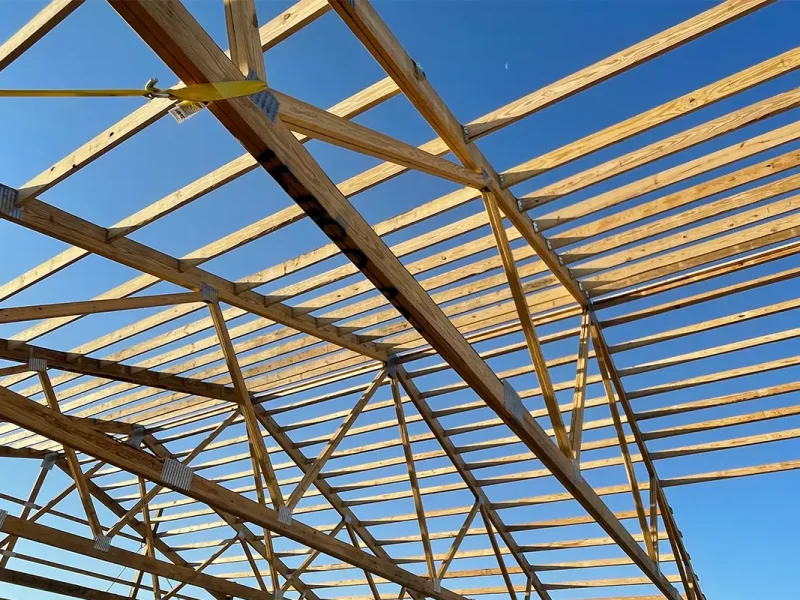
From roof purlins and bracing to columns, girts, sheathing, and fasteners, every element is engineered to work together for maximum strength.
Code Compliance and Beyond
Your building will meet or exceed local wind and snow load requirements.
Single-Source Supplier
- Eliminate the stress of coordinating multiple suppliers focused only on their components.
- Rely on Lester as your trusted, all-in-one building system provider.
- Every Lester building is custom designed to meet your specific needs.
- Our industry leadership is backed by continuous product innovation, rigorous quality control, and thorough testing.
Lifetime Structural Warranty
Lester Buildings are expertly engineered for strength and reliability, backed by a Lifetime Structural Design Warranty. Explore the warranty coverage for new buildings below.
Structural Design: Lifetime (or 50 years for businesses)
Treated Lumber: 50 years
Painted Steel: 35–40 years
Workmanship: 1 year
Roof Leaks: 5 years
Quality Components
Even the best-engineered pole barn is only as strong as the materials it’s built with. That’s why every Lester building starts with top-tier components—carefully selected and crafted for performance, durability, and long-term value. Here are just a few examples of our commitment to quality.
Perma-Column® Foundation Option
Lester Buildings offers Perma-Column® precast concrete columns as a durable alternative to traditional wood posts. These permanent foundation solutions are:
- Made of reinforced precast concrete to resist rot, decay, and insect damage
- Designed to keep wood posts above ground, protecting them from moisture
- Engineered for strength and long-term performance
- Compatible with other Lester foundation options, like precast footings and concrete collars
Perma-Columns® add lasting value and peace of mind to your post-frame building foundation.
Lumber
Lester trusses are custom-built to order using high-strength, mechanically tested MSR southern yellow pine or Douglas fir for reliable, consistent performance—unlike standard human-graded lumber. A two-step pressing process ensures superior truss plate engagement and structural integrity. Quality is reinforced through random TPI inspections, and MSR lumber is used throughout the entire framing system for strength and consistency in every component.
Steel
Lester uses heavier 28-gauge steel panels for roofs and walls—stronger than the industry-standard 29-gauge—with an option for 26-gauge. Every layer, from steel coil to paint, is specified, tested, and roll-formed in-house for consistent quality and durability.
Fasteners and Connections
While typical post-frame buildings use a single nail for purlin attachment, Lester uses metal saddle hangers with nested purlins and eight fasteners for superior strength. Trusses are nested between column plies for stronger joints, and each column is engineered for its specific role. Finger-jointed column splices further enhance strength over solid wood.
Are you ready to build your dream building?
FAQs
We've compiled answers to common questions about post frame construction to help you make informed decisions.
What is an engineered pole barn—and why does it matter?
An engineered pole barn is designed to meet all local building codes and load requirements, ensuring every component—from roof trusses to the foundation—works together for maximum strength and stability. Materials are specifically chosen for durability, like higher-grade lumber and custom steel specs. The result? A structure built to last, with no weak links.
Not all post-frame pole barns are engineered, and those that aren’t may be at risk of failure. For example, if your trusses are built to handle heavy snow loads but your columns are only rated for lighter ones, the columns become the weak link. When a heavy snowfall hits, your trusses might hold—but your columns could buckle, leading to a partial or total collapse. In a properly engineered building, every component is designed to work together—no weak links, just strength and stability throughout.
What's the difference between fully engineered and partially engineered pole barns?
A fully engineered pole barn is designed as a complete system—every part is built to work together, with no weak links. In contrast, a building with engineered components may have strong individual parts, but they aren’t necessarily designed to function cohesively. For instance, a truss rated for a 30-pound load doesn’t guarantee that the foundation, columns, or purlins can support the same load.
What is a single-source responsible supplier?
Some builders piece together materials from multiple vendors—trusses from one, columns from another, and steel from yet another. A single-source supplier, like Lester, manufactures all major components in-house—from columns and trusses to steel panels and bracing. That means one company is fully accountable for the performance of the entire building.
Is there a difference between a pre-engineered and an engineered building?
Absolutely. A pre-engineered building is more of a one-size-fits-all solution. Builders often use the same components—like a standard 3-ply 2×6 column—across a wide range of building sizes, regardless of whether it’s structurally appropriate. Some also rely on prescriptive designs, using generic tables to size components without accounting for site-specific factors.